

ANNUAL SURVEY 2025
BRAZILIAN IMMIGRANTS LIVING IN CANADA
The annual survey conducted by the House of Brazilian Culture in Canada aims to gather insights that help support cultural and educational initiatives within the Brazilian community in Canada. Our analyses intend to help individuals from civil society, public institutions, and private companies gain a more in-depth understanding of the Brazilian diaspora. Additionally, we strive to promote social integration initiatives and encourage collaboration between associations with similar interests. More specifically, our research will help you:
- Better understand the profile of Brazilian immigrants and the many Brazilian communities in Canada;
- Develop strategies for social integration and for promoting Brazilian culture;
- Promote initiatives that strengthen and expand the presence of the Portuguese language in Canada.
- Create and/or share materials that support the goals of the groups analyzed.
To learn more about our Research and Development team, please contact us at
METHODOLOGY
The 2025 survey performed its data collection through two online forms, one of them targeting individuals of Canadian descent and the other for people of Brazilian descent, both deployed as Google Forms. The form for Brazilians combined qualitative and quantitative approaches, featuring a total of 44 questions (6 open-ended and 38 multiple-choice). The general questions were mandatory, while those possibly not relevant to all participants remained optional.
Data collection was anonymous, as no personally identifiable information was requested. The form was primarily shared with Brazilians via 126 Facebook groups dedicated to the Brazilian community in Canada. We also made less frequent posts on our official LinkedIn and Facebook pages to complement outreach.
The survey forms were published on the House’s website and remained available from June 15 to September 30, 2025. All stages of the project, including developing the survey itself, its distribution, the data analysis, and further publication of its results, were executed free of charge thanks to the volunteer work of the House’s Research and Development team.
STRUCTURE
Part 1: Demographic Analysis
The first section of the study offers an overview of the sociodemographic profile of Brazilian immigrants in Canada, analyzing variables such as age, gender, region of birth, and residence in Brazil. It also includes the province of current residence in Canada. We looked into reasons for moving abroad and family context around the time of migration. Combined, such data will provide valuable insight into the contexts of origin and settlement of the Brazilian community in Canada.
Part 2: Linguistic Analysis
The second part of the research examines the linguistic repertoire of Brazilian immigrants, taking into account their retention of the Portuguese language and proficiency in English and French. The analysis identifies how and in which countries the participants learned and developed their non-native languages, highlighting indicators of access to language education in both Brazil and Canada. We also investigated how often the Brazilian community uses Portuguese in Canada and what motivates them to maintain their native language in the host country. This understanding is essential for developing actions to maintain the Portuguese language in different social and professional contexts in Canada.
Part 3: Sentiment Analysis
The third part explores the feelings and perceptions of Brazilian immigrants on their experience of living in Canada. It addresses aspects such as expectations for academic and work performance, potential difficulties in finding housing, achieving financial stability, integrating family members, and making friends. Overall, the analysis sheds light on the elements that shape the well-being of the Brazilian community, both in the first six months after arrival and throughout their current life in Canada.
Part 4: Analysis of Intercultural Relations
The final section of the study examines how Brazilian immigrants relate to Canada and its communities. It assesses whether they felt welcome among both Canadians and Brazilian immigrants previously settled in Canada, as well as what they like and dislike the most in their new country and its main shortcomings compared to Brazil. Finally, participants were invited to leave a message addressed to people of Canadian origin, offering a glimpse into their expectations and emotions about intercultural coexistence.
RESULTS
Between June 15 and September 30, 2025, we collected 196 responses from Brazilian immigrants living in Canada. Of these, 173 participants completed the Portuguese version of the survey, and 23 completed the French version; no responses were received for the English version. The results are presented in sections, and each section is accompanied by comments summarizing our overall findings. We also highlight emerging themes for future initiatives.
Part 1: Demographic Analysis
The survey reached a considerably larger group of women, with most Brazilian respondents aged between 31 and 50. Over half of the participants were born and had lived in Brazil’s Southeast region for most of their lives, suggesting that residents of this region may be more likely to immigrate to Canada. Reasons for moving also varied considerably, with “Other” emerging as the most frequent response. For future editions, adding a field for participants to specify their “Other” reason could help provide more insights.
The length of residence in Canada is relatively evenly distributed, with most participants having lived in Canada between 1 and 6 years. More than half of the respondents currently reside in the province of Quebec. In further editions of the survey, a point for improvement would be striving for more equitable reporting across Canada’s provinces and territories, an effort that will likely increase the diversity of responses to this question. As for family context, most Brazilian immigrants reported having moved to Canada accompanied by at least one family member, followed by a significant number of respondents who migrated alone.
Topics to Develop:
- The Southeast region as a hub for immigration;
- Integration challenges for immigrants moving with family members;
- Challenges to maintaining one’s Portuguese language skills for immigrants moving unaccompanied.
What is your age group?
196 answers
No Data Found
Which gender do you identify with?
196 answers
No Data Found
In which region of Brazil were you born?
196 answers
No Data Found
In which region of Brazil did you spend most of your life?
196 answers
No Data Found
In which province or territory in Canada do you currently live?
196 answers
No Data Found
How long have you lived in Canada?
196 answers
No Data Found
What was the main reason you moved to Canada?
196 answers
No Data Found
Did you move alone or with family?
196 answers
No Data Found
What is your age group?
196 answers
No Data Found
Which gender do you identify with?
196 answers
No Data Found
In which region of Brazil were you born?
196 answers
No Data Found
In which region of Brazil did you spend most of your life?
196 answers
No Data Found
In which province or territory in Canada do you currently live?
196 answers
No Data Found
How long have you lived in Canada?
196 answers
No Data Found
What was the main reason you moved to Canada?
196 answers
No Data Found
Did you move alone or with family?
196 answers
No Data Found
Part 2: Linguistic Analysis
How often do you speak Portuguese?
196 answers
No Data Found
How often do you write in Portuguese?
196 answers
No Data Found
How do you maintain your connection to the Portuguese language?
196 answers
No Data Found
No Data Found
How do you feel about maintaining your native language while living in Canada?
196 answers
No Data Found
No Data Found
How often do you speak Portuguese?
196 answers
No Data Found
How often do you write in Portuguese?
196 answers
No Data Found
How do you maintain your connection to the Portuguese language?
196 answers
No Data Found
No Data Found
How do yout feel about maintaining your native language while living in Canada?
196 answers
No Data Found
No Data Found
The linguistic analysis section can be subdivided into two categories: data related to mother tongue and info on non-native languages. Regarding the mother tongue, over 80% of participants reported speaking Portuguese every day. A considerably smaller percentage (around 60%) write in Portuguese daily. Fewer than 3% of respondents stated very rarely speaking or writing in Portuguese, suggesting that, for most Brazilian immigrants, contact with Portuguese as a native language remains strong even after immigrating to Canada.
For most Brazilians surveyed, conversations with family and friends remain the primary way to stay connected to their mother tongue. Reading content produced in Portuguese ranks as the second most common form of contact, followed by the consumption of audiovisual content. Most respondents believe it is important to maintain a balance between using Portuguese and Canada’s official languages. Finally, approximately 37% of Brazilians reported that all or virtually all Canadians they know are unaware that Portuguese is the official language of Brazil.
How many languages do you speak in addition to Portuguese?
196 answers
No Data Found
How often are Canadians surprised when you tell them Brazilians speak Portuguese (not Spanish)?
196 answers
No Data Found
How would you describe your French proficiency?
196 answers
No Data Found
How would you describe your English proficiency?
196 answers
No Data Found
Where did you learn the non-native languages you speak?
196 answers
No Data Found
No Data Found
How many languages do you speak in addition to Portuguese?
196 answers
No Data Found
How often are Canadians surprised when you tell them Brazilians speak Portuguese (not Spanish)?
196 answers
No Data Found
How would you describe your French proficiency?
196 answers
No Data Found
How would you describe your English proficiency?
196 answers
No Data Found
Where did you learn the non-native languages you speak?
196 answers
No Data Found
No Data Found
Regarding non-native languages, 77% of participants declared speaking two or more languages in addition to Portuguese. Proficiency levels are higher in English than in French, and more Brazilians learned French in Canada than English. Approximately 29% of participants do not speak French, while only 5.6% stated they do not speak English. Regarding how they acquired their non-native languages, most Brazilians took language courses; only 7 participants studied their new languages at a university level.
Topics to Develop:
- The family as a means of maintaining the mother tongue in immigration contexts;
- The importance of promoting Portuguese-language written content creation channels in Canada;
- The relevance of Portuguese-language audiovisual media channels in Canada;
- Raising local awareness for the fact that Portuguese is the official language of Brazil;
- Diverse English and French teaching scenarios in Brazil and Canada;
- Shortage of language teaching initiatives in university contexts;
- The competitive advantage of French in Canada.
Part 3: Sentiment Analysis
During your first six months in Canada, how did you feel about speaking the local languages?
196 answers
No Data Found
How do you currently feel about speaking the local languages?
196 answers
No Data Found
During your first six months in Canada, how did you feel about maintaining a stable income?
172 answers
No Data Found
How do you currently feel about maintaining a stable income?
187 answers
No Data Found
During your first six months in Canada, how did you feel about finding housing?
164 answers
No Data Found
How do you currently feel about finding housing?
164 answwers
No Data Found
During your first six months in Canada, how did you feel about performing well at work?
151 answers
No Data Found
How do you currently feel about performing well at work?
185 answers
No Data Found
During your first six months in Canada, how did you feel about performing well in school?
151 answers
No Data Found
How do you currently feel about performing well in school?
115 answers
No Data Found
During your first six months in Canada, how did you feel about helping your family settle in?
126 answers
No Data Found
How do you currently feel about your family?
132 answers
No Data Found
During your first six months in Canada, how did you feel about making friends?
196 answers
No Data Found
How do you currently feel about making friends?
196 answers
No Data Found
During your first six months in Canada, how did you feel about speaking the local languages?
196 answers
No Data Found
How do you currently feel about speaking the local languages?
196 answers
No Data Found
During your first six months in Canada, how did you feel about maintaining a stable income?
172 answers
No Data Found
How do you currently feel about maintaining a stable income?
187 answers
No Data Found
During your first six months in Canada, how did you feel about finding housing?
164 answers
No Data Found
How do you currently feel about finding housing?
164 answwers
No Data Found
During your first six months in Canada, how did you feel about performing well at work?
151 answers
No Data Found
How do you currently feel about performing well at work?
185 answers
No Data Found
During your first six months in Canada, how did you feel about performing well in school?
151 answers
No Data Found
How do you currently feel about performing well in school?
115 answers
No Data Found
During your first six months in Canada, how did you feel about helping your family settle in?
126 answers
No Data Found
How do you currently feel about your family?
132 answers
No Data Found
During your first six months in Canada, how did you feel about making friends?
196 answers
No Data Found
How do you currently feel about making friends?
196 answers
No Data Found
In this section, we compare the experience of Brazilian immigrants during their first six months living in Canada. When it comes to Canada’s official languages, all levels of initial concern converted to enthusiasm or neutrality over time, indicating that Brazilian immigrants feel linguistically integrated at a local level.
Maintaining a stable income was identified as a major source of concern for more than half of participants during their first months in Canada; however, over time, such concerns shifted towards neutrality. The opposite trend was observed in relation to finding housing: while 34% of respondents viewed this challenge with neutrality during their first six months as immigrants, nearly half of that group now expresses significant concern. Levels of enthusiasm regarding the search for housing have remained virtually unchanged.
Another factor that seems to have caused significant concern during one’s first six months living in Canada is work performance; nonetheless, over time, concern gave way to enthusiasm. A similar trend is observed for academic performance, where levels of concern also shifted towards neutrality and enthusiasm.
Initially, for approximately 60% of Brazilians who immigrate with a family member, integrating their relatives is either a concern or a major concern. Here, once again, we notice a shift into neutrality and enthusiasm over the months. Finally, most Brazilians approach the challenge of making friends with neutrality and enthusiasm, both during the initial six months and afterwards.
Topics to Develop:
- Effects of the housing crisis on the Brazilian community in Canada;
- Sense of linguistic integration among Brazilian immigrants in Canada;
- Sense of professional integration among Brazilian immigrants in Canada;
- Family integration strategies for Brazilian immigrants in Canada.
Part 4: Analysis of Intercultural Relations
How would you describe the way Brazilians welcomed you in Canada?
196 answers
No Data Found
How would you describe how welcoming Canadians have been towards you?
196 answers
No Data Found
How would you describe the interest of Brazilian immigrants in Brazilian community events or initiatives in Canada?
196 answers
No Data Found
How interested do you think Canadians are in Brazil?
196 answers
No Data Found
How strong is the presence of the Brazilian community where you live?
196 answers
No Data Found
In your opinion, which aspects of Brazil interest Canadians the most?
196 answers
No Data Found
How would you describe the way Brazilians in Canada welcome you and others?
196 answers
No Data Found
How would describe how welcoming Canadians have been toward you?
196 answers
No Data Found
How would you describe the interest of Brazilian immigrants in Brazilian community events or initiatives in Canada?
196 answers
No Data Found
How interessed do you think Canadians are in Brazil?
196 answers
No Data Found
How strong is the presence of the Brazilian community where you live?
196 answers
No Data Found
In your opinion, which aspects of Brazil interest Canadians the most?
196 answers
No Data Found
Brazilian immigrants recently arrived in Canada viewed the welcome from people of both Brazilian and Canadian origins as very similar. When asked about how interested these groups are in Brazil, participants stated that Brazilians show slightly more interest than Canadians. Most respondents described the presence of the Brazilian community where they live as average, weak, or very weak.
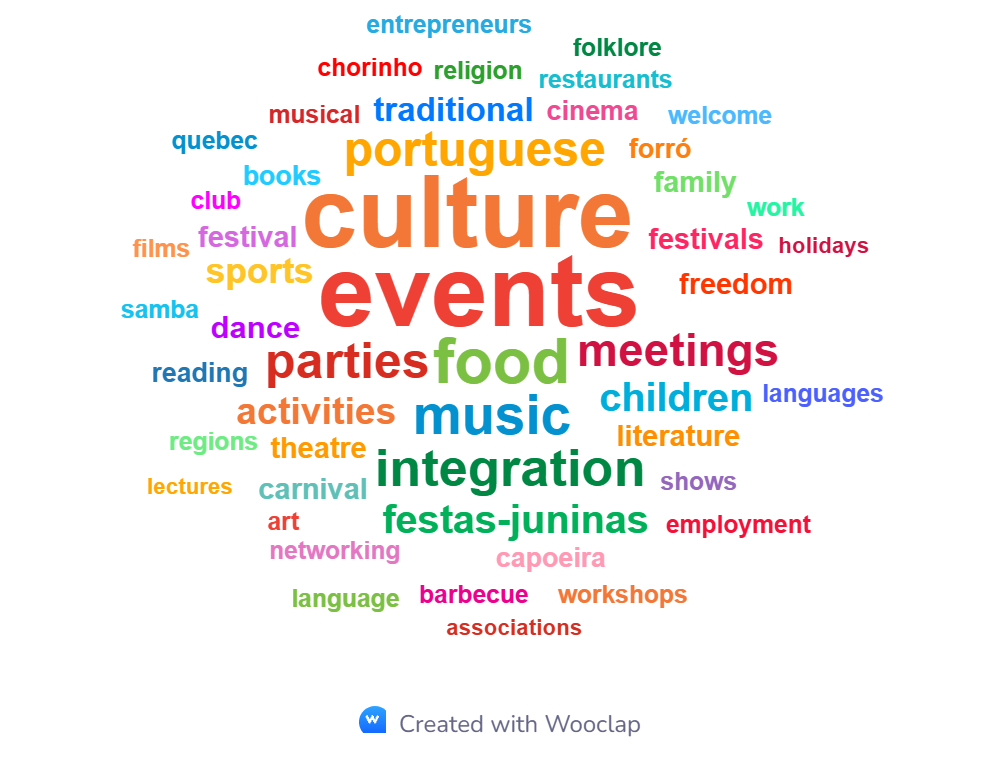
When asked about how Canadians express their interest in Brazil, more than half of the responses mentioned cuisine, music, and dance as the main points of attraction. Religious traditions and literature do not seem to be of much interest to Canadians. Finally, as illustrated in the next category, Brazilian immigrants emphasized their wish to participate in more cultural events and gatherings centered around music, food, sports, and Portuguese language learning.
Topics to Develop:
- Strategies to strengthen the Brazilian community dwelling outside major Canadian cities;
- Brazilian music and dance as elements of cultural attraction in Canada;
- Brazilian cuisine as an element of cultural attraction in Canada;
- Expand the offer of Portuguese language courses as a foreign and heritage language.
What do you miss the most about life in Brazil?
196 answers
What do you miss the least about life in Brazil?
196 answers
What do you miss most when you think about life in Brazil?
196 answers
What do you miss least about life in Brazil?
196 answers
What do you like the most about life in Canada?
196 answers
What do you like the least about life in Canada?
196 answers
What initiatives would you like the Brazilian community to organize where you live?
132 answers
If you could send a message to all Canadians, what would it be?
196 answers
No Data Found
What do you like most about life in Canada?
196 answers
What do you like least about life in Canada?
196 answers
What initiatives would you like the Brazilian community to organize where you live?
132 answers
If you could send a message to all Canadians, what would it be?
196 answers
No Data Found
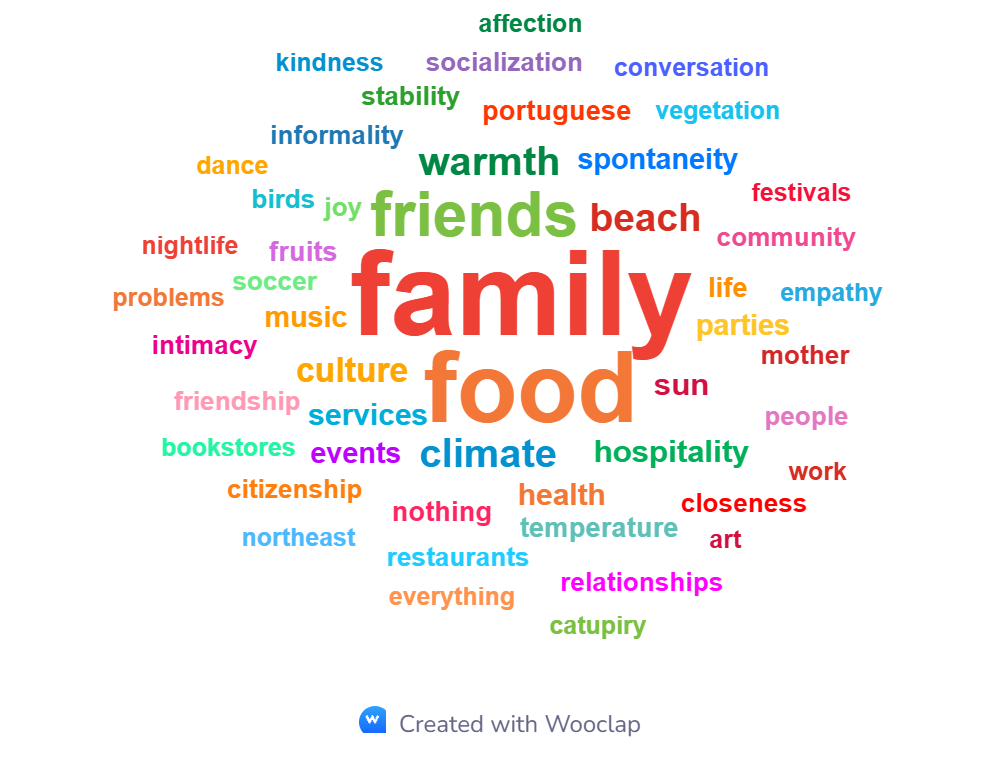
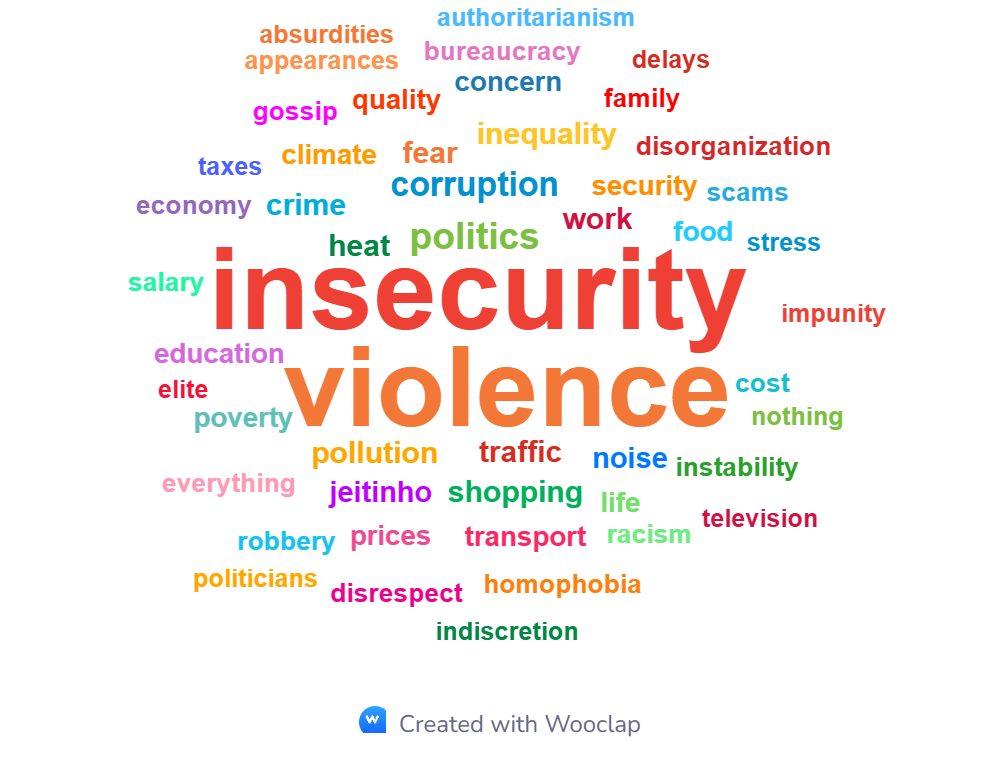
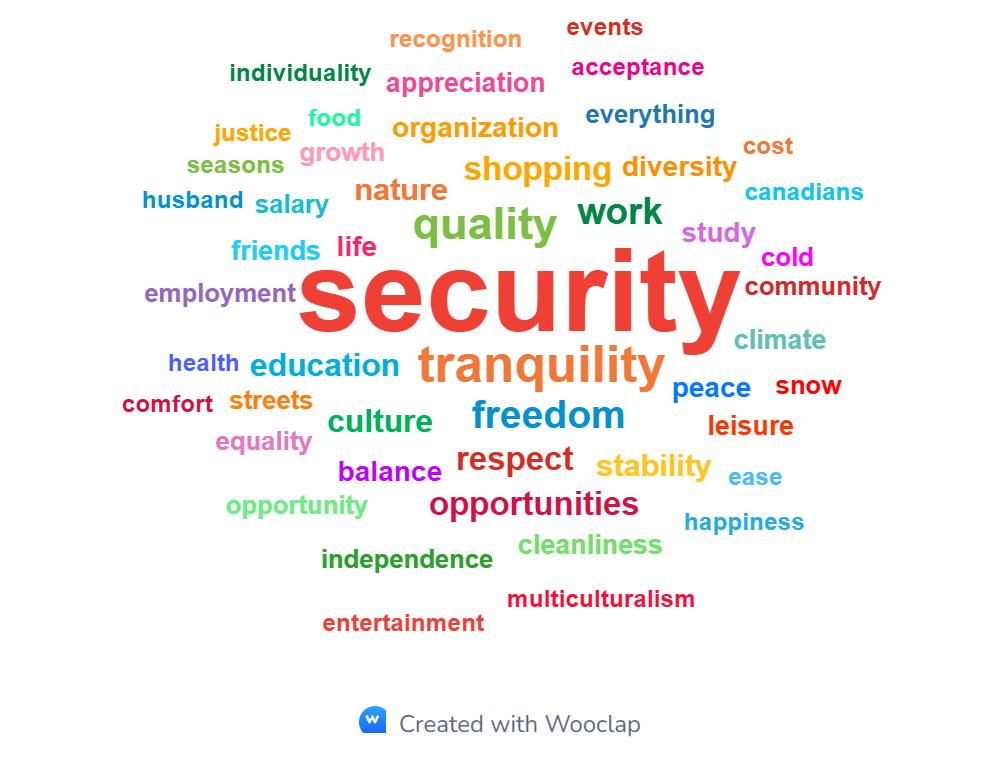
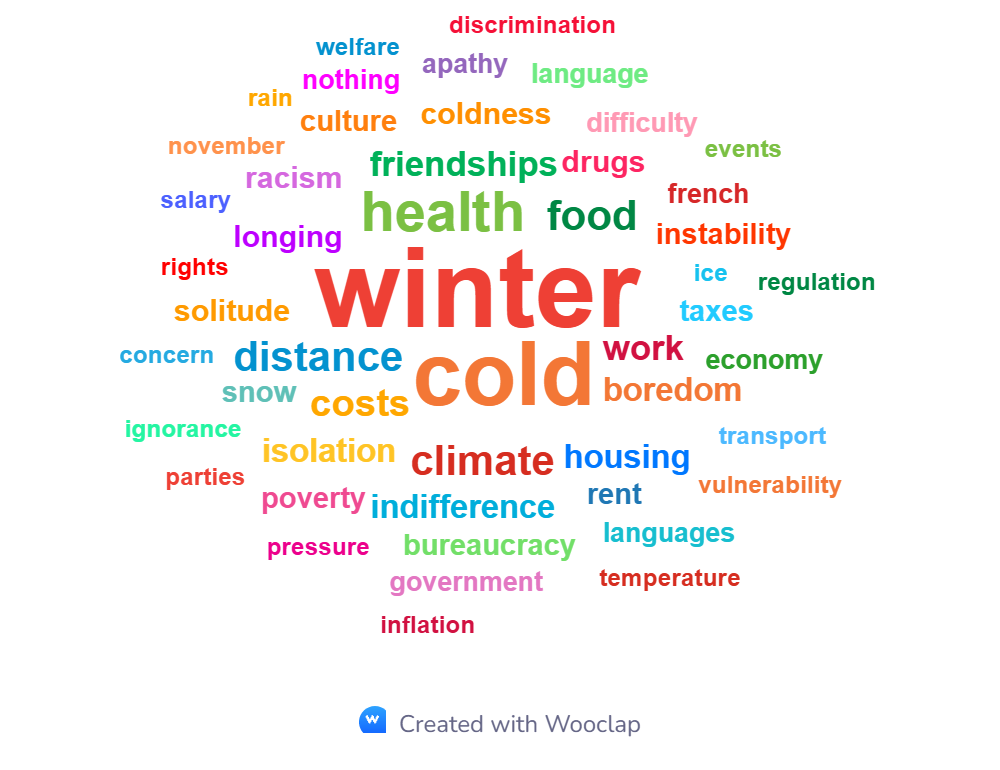
In analyzing the responses to the open-ended questions, we used word cloud technology to generate images in which words appear in different sizes according to how often they appear in the response texts. To improve the quality of the analyzed samples, we took into account keywords only, such as nouns and verbs, and ignored less significant grammatical elements such as prepositions and conjunctions.
Brazilian immigrants in Canada listed their family and Brazilian cuisine as the elements they miss the most. Conversely, almost all participants agree that violence and the feeling of insecurity are the least appealing aspects of living in Brazil. In contrast, safety and tranquility were identified as the most valued aspects of life in Canada for Brazilian immigrants. Finally, the cold and very long winters were reported as the main drawback of the host country.
Topics to Develop:
- The role of public security policies in attracting Brazilian immigrants to Canada;
- Family as a connection between Brazilian immigrants and their country of origin;
- Cuisine as a source of national pride for Brazilian immigrants.
In the final question of the survey, we asked participants to leave a message for Canadians. The question was intentionally designed to be as open-ended as possible, allowing Brazilian immigrants to freely express their thoughts and emotions. When analyzing these responses, we categorized the messages as positive, negative, or neutral, based on indicators such as irony, indifference, praise, and other expressive elements.
Some negative messages highlighted the apparent emotional distance of Canadians in contrast with the “human warmth” Brazilians are used to. Part of the negative input alludes to refractory behavior from Canadians regarding the presence of immigrants in Canada, and, in some cases, the strictness of their language requirements. In short, the prevailing idea is that immigrants should not be considered enemies but rather as contributors to Canada’s growth. Neutral messages stemmed mostly from participants who didn’t really know what to say or preferred not to speak out.
Most of the positive messages expressed gratitude for the warm welcome received, along with appreciation for Canada’s natural beauty and the positive aspects of Canadian society. Besides, in this sample of messages, participants encouraged Canadians to experience the culture, cuisine, and landscapes not only of Brazil but of Latin America as a whole.
FINAL CONSIDERATIONS
Thinking of future editions for this survey, we are glad to have identified opportunities for improvement, primarily in what pertains to our dissemination strategy. Due to limited resources within the Research and Development team in 2025, the questionnaire was distributed through rather few channels and only reached specific regions. In the coming years, we intend to implement the following points for improvement:
- Extend similar outreach efforts into all Canadian provinces and territories;
- Diversify outreach channels (social media, printouts, in-person meetings);
- Ensure a more equitable distribution between the target audiences of both surveys (Brazilians and Canadians).
We believe such approaches will increase the representativeness of our samples and, as a result, enhance the quality of both data collection and analysis in future editions. For more information on our Research and Development team, please contact us at
Made with ❤ by Horizon Tecnologias. All rights reserved.